Industrial Revolution

Here I go again on a periodic tangential blog post.
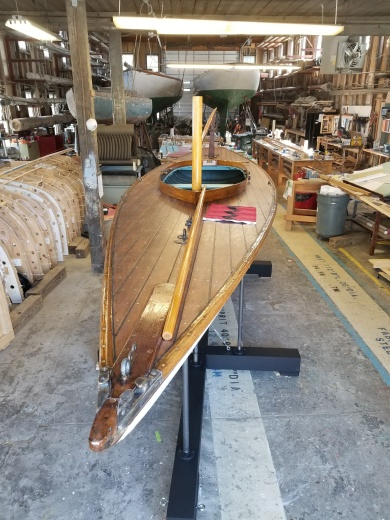
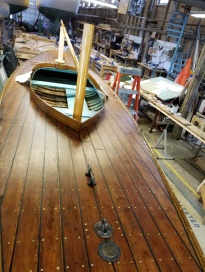
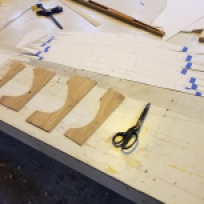
As you can see in the enclosed picture, we are laying out all the fittings that go on deck.

We have beautiful cleats from J. M. Reineck done in his business shop on a CAD machine with all the machine tools and jigs to make many parts exactly the same, including posts to fasten these cleats to the deck. On the other hand, we have exquisite craftsman-made parts from Mike Mirman in his home shop.

BUT, it is so nice to just create one template for drilling attachment holes for 15″ cleats rather than custom-fitting attachments for each of the dozen #6229 pad eyes! SO, didn’t we just have an INDUSTRIAL REVOLUTION moment on the RELIANCE Project! As Tim Horton (Our team psychologist and jack of all trades) said “You didn’t think that Henry Ford custom-made each cylinder did you?” I must admit I DO like the custom, craftsman approach. There is something about the statement” HAND MADE IN THE USA BY A CRAFTSMAN” but wouldn’t it be nice to have CAD accurate parts with engineered strength already confirmed; if only it were cheaply and readily made! We’d be done and you’d be enjoying this beautiful replica.

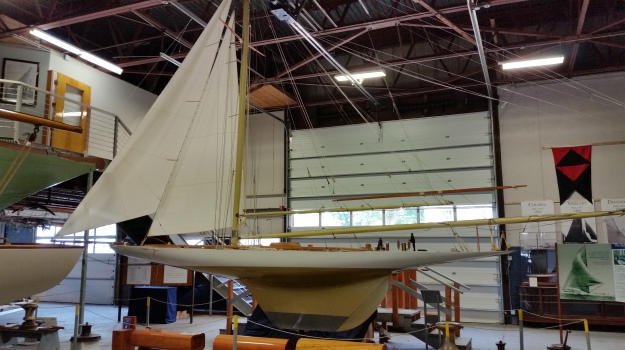
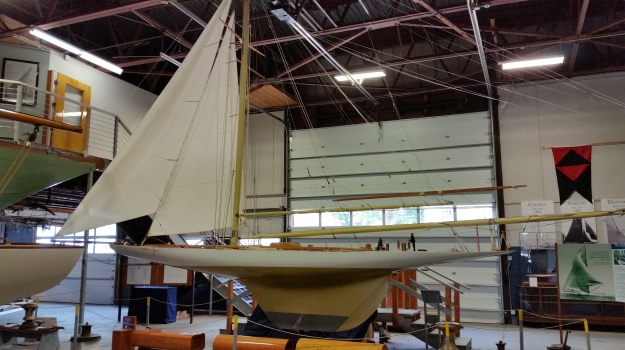
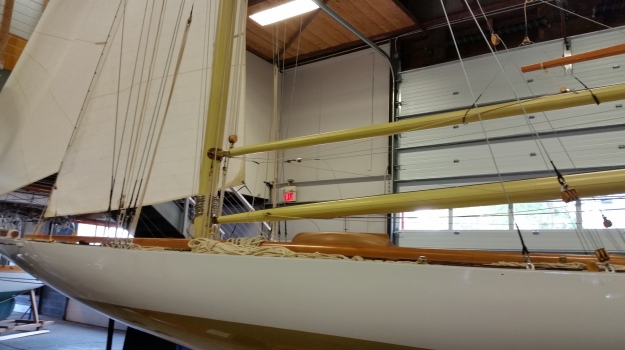
BTW, in the picture, we have cut off 4′ of extra length from our mast and fitted it as a stump mast for the time being. I think we’ll hang the boom from it shortly, if for no other purpose than reminding us of the immense size and girth of these two sticks and to get us giggling about building such a monster in one-sixth scale with such tiny fittings attached to such large sticks. We do have those moments!

20130427_145240

20130502_125633

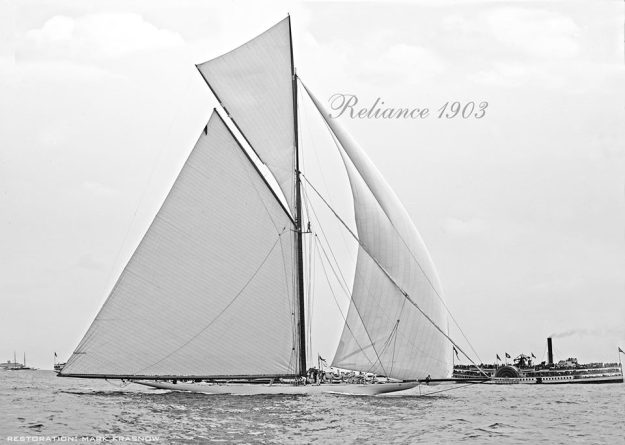
110th Anniversary of RELIANCE

110th anniversary of RELIANCE being turned over to the Iselin Syndicate.

April was an exciting month for RELIANCE.

April 10th: RELIANCE was launched
April 25th: RELIANCE first sailed
April 28th: RELIANCE was turned over to the Iselin Syndicate

From this date RELAINCE has about 130 exciting days in the water to conclusion of America’ Cup and her career. Follow her journey with posts from John Palmieri, Curator Emeritus.

Exciting Events This Weekend

This weekend marked a number of key events for the RELIANCE Project which we’d like to share.

First, and very importantly, on Saturday Joe and Barbara Bartram, who have generously provided the funds to build RELIANCE and have been our strong cheerleaders, made a visit from Florida to our Building 28 to see our progress for themselves. A very, very happy time for all involved. As you can see, a number of our team members were able to be on hand. I’d like to thank them and all of the team for their support! HURRAH!

Sunday marked the opening of Herreshoff Museum for the summer season with a very successful open house. There was a constant stream of visitors to Building 28 that I had no time for lunch or any concept that that closing time had come and gone! Three highlights to mention among the many from the day:
- A visit by Marty and Stan Livingston whose picture I enclose
- The children (and adults) who were awed by RELIANCE and her G.I. Joe sailors. As you can see in one of the pictures, our team member Denise Bolduc has been making RELIANCE-correct uniforms for our 45 G.I. Joes, now known as Sven. Several of the girls have asked if they could have a dressing party when the uniforms are completed and the Svens are to be placed on RELIANCE. Way Cool! (P.S. I bet you didn’t know that Capt. Barr was a USMC reservist)
- A late afternoon closing time visit by “Chuck” who overheard Jim Reinbeck, his son and I talking about making 40′ of sail slide track and 200 sail slides to scale. It turns out that Chuck is a retired machinist, tool and die guy who also taught at the Jewelry Institute. He can read and interpret complex plans upside down faster than anyone I’ve ever seen. And then come up with such simple and creative solutions!!! Wow. After an incredibly interesting (and intense for me) hour Chuck had to hurry off. So Chuck, if you read this please come visit us. We need you!

Mike Mirman, Joe Bartram, Sandy Lee, Bill Lawton

Mike Mirman, Joe Bartram, Sandy Lee, Bill Lawton

Mike Mirman, Joe Bartram and Sandy Lee looking over Mike's castings

Mike Mirman, Joe Bartram and Sandy Lee looking over Mike’s castings

Sven and Barr, USMC

Sven and Barr, USMC

Livingston's visit Stan on deck, Marty and Sandy

Livingston’s visit Stan on deck, Marty and Sandy

Rough Mast

We received a rough mast that we’ll be shaping into Reliance shape. It has the proper taper at the top most 3 1/2′ and is a straight stick for the remainder – just like the original. Ours is 8′ too long for now, but much better than too short!! Enlosed pictures show the mast with our telescoping topmast inserted and #1 club topsail yard two blocked against it, so you can see how tall the rig will be.

Meet the Team

Keith Bradley is our Jack of All trades and master of everything he does! He’s been one of one woodworkers – the topmast is his baby – and metal worker – you should see his topmast fid!

Originally from Detroit, he has resided in Falmouth for many years where although retired from Woods Hole Oceanagraphic Institute, he still works there part-time. Few have had as varied a career as Keith; building upon undergraduate and advanced degrees in engineering from Notre Dame and Michigan (who does he root for?) and an MBA from Babson.
He has worked as an officer with NOAA, for Chrysler, and WHOI. At WHOI he was Operation Group Manager building very deep ocean instrumentation and deep sea buoys.

I am always struck by how unusual and special volunteers are. Never knew until getting background for this post, for example, that Keith teaches Science Lab at Babson and has been a Special Olympics swimming coach for 25 years!

Keith Bradley

Keith Bradley

Bill Lawton is the heart and soul of our Reliance crew. Having been a professional boat builder and furniture maker, he is our go-to guy. We often find him chuckling to himself that he can’t believe he’s building a big boat with 1/6th scale miniature parts.

Bill apprenticed as a furniture maker during high school before joining the Marine Corps for a decade. Leaving USMC he returned to furniture making but quickly joined Pearson to lead their woodworking shop at what is now our Herreshoff Museum campus. He left Pearson for stints at a number of boat bulders including Hunter as head of their R&D shop and Gulfstar (where he built 150′ boats for the Carribean trade) before finally owning his own boatyard.

During his boat building career he built wooden, fiberglass, and ferro cement yachts. He eventually left boatbuilding for a more stable life as a general contractor which he continues today on a part time basis in his “retirement” phase.

So now almost 50 years later, he is back in Building 28 where his boat building career began!

Bill Lawton

Bill Lawton

Check back for more profiles on the rest of our RELIANCE team.

Finishing the Boom

We’ve finished our the basic construction of our boom and will put it aside until we’ve completed fabricating the sail track and casting all the fittings that go onto the boom.

As shown on the accompanying sketch, the original boom was fabricated metal, with steel plates riveted over rings and angle iron stringers. Rivets were ground flush so in our scale they would not appear. Much of the boom was a “straight stick” of 21″ diameter; with common upper and lower plates (shown as B-1 which were 14″ long and rolled half round). It would appear that this simplified construction. The top halves overlapped the bottom halves, while the ends were butt-jointed together and fastened inside and out to straps with rivets. As mentioned, these plates were also riveted to rings and stringers. I imagine that they must have made a jig or tool to buck the inside end of the rivet, but would appreciate any insight from our readers. I cannot imagine there was anyone small enough to fit inside these rings and the 21″ diameter pipe! Typically, there were four rings equally spaced 3’6″ inside each section of plate and plates were jointed half-way between adjoining rings. Top and bottom plates were alternatively arranged to minimize weak points.

We should note that mid-May 1903 after a month of sailing, NGH added 3′ to the boom ( and 18″ to the gaff) and had the sails recut.

We built our boom of “Lawton Steel” named for our chief woodworker; hence wood made to look like steel. We laminated two 20′ long douglas fir 1″ x 4″ planks together to make a top and bottom. From a fifth plank we cut two 1/2″ strips which we glued a little proud of the edges of the second lift of the bottom half. Thus, the final shape would be of five planks and almost square in profile.

We routed out the insides of each half to give us walls of 1/2″ in thickness, which we believe to be strong enough but as light as possible. After shellacking the inside hollow portion we glued the halves together. We marked lines on the square profile to represent edges for an octagon and then planed these to perfect octagonal profile. Next, we knocked of these edges and sanded until we were nearly round. At this point we created our overlapped upper plate joints with thin strips of basswood, filling in as necessary with Bondo. Thin basswood strips were also added to represent the butt joint straps. We painted our boom with several coats of primer, sanding between each coat until we achieved a metallic finish.

We’ll put on a final coat of paint, but for now our boom hangs in its rack awaiting completion of the many cast fittings that’ll be attached later.

Sketch of Boom

Sketch of Boom

Boom being sanded to look like metal

Boom being sanded to look like metal

Boom after plating seams added

Boom after plating seams added

Boom after plating seams added

Boom after plating seams added

Boom rounded to shape

Boom rounded to shape

Tim does final sanding on boom

Tim does final sanding on boom

Keith planing octagon shape to boom

Keith planing octagon shape to boom

Keith knocks corners off the octagon

Keith knocks corners off the octagon

Squared boom is made into an octagon

Squared boom is made into an octagon

Bill takes Squared boom to an octagon

Bill takes Squared boom to an octagon

Hollow halves glued together

Hollow halves glued together

Ready to be glued together

Ready to be glued together

Insides have been shellacked

Insides have been shellacked

Bill Routs out other half of boom

Bill Routs out other half of boom

Routing out hollow boom half

Routing out hollow boom half